Now Reading: The Saga of the Nana Benz: Queens of Cloth and Pillars of the West African Economy
-
01
The Saga of the Nana Benz: Queens of Cloth and Pillars of the West African Economy

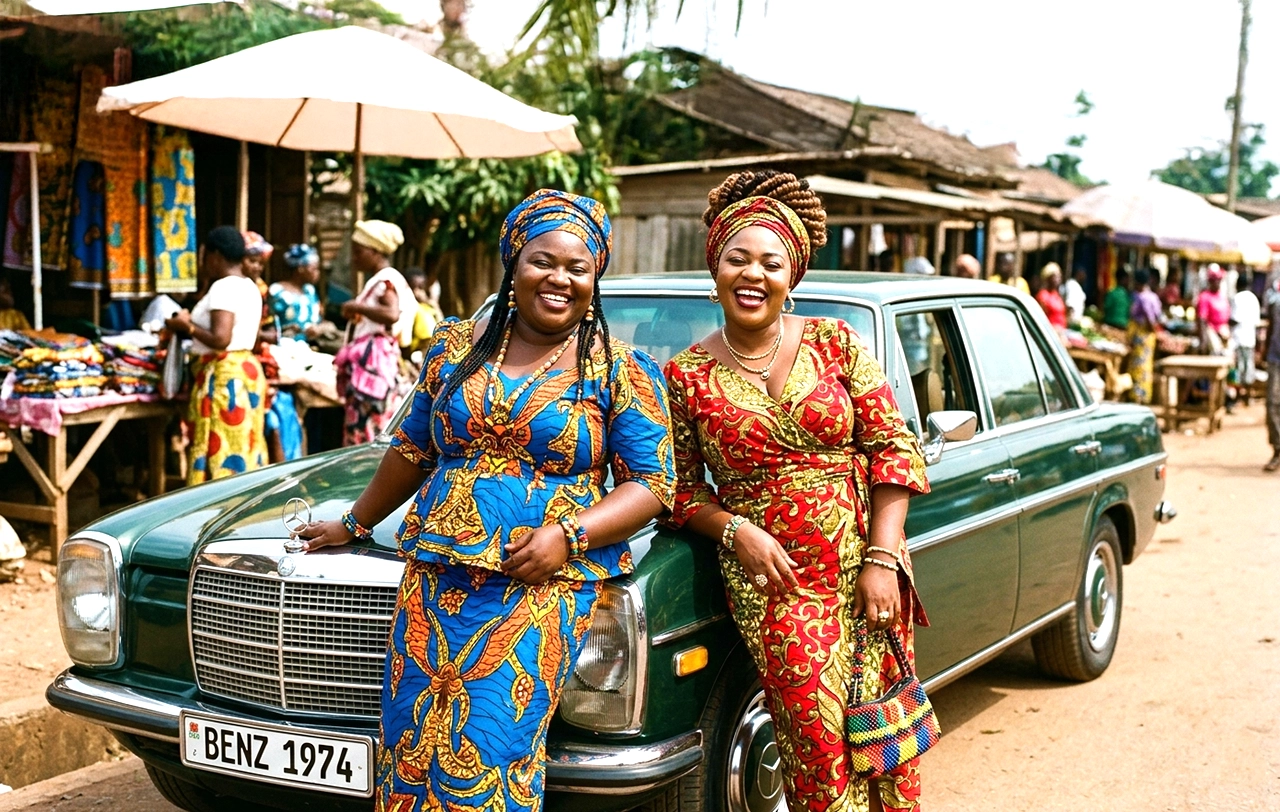

They turned fabric into a language and success into a signature. Rediscover the story of these exceptional women who dominated the Lomé market and left an indelible mark on the history of global female entrepreneurship.
In the economic history of the 20th century, few figures are as fascinating as the Nana Benz. These Togolese businesswomen—true pioneers of female entrepreneurship—built commercial empires from nearly nothing. Their name has become a universal symbol of success, resilience, and African elegance.
The Origin of a Myth: Why “Nana Benz”?
The term “Nana Benz” is not an official title, but a popular nickname born in the 1960s and 1970s in Lomé. It illustrates a perfect fusion of tradition and modernity:
- “Nana”: In the Ge (Mina) language, this means “mother” or “grandmother.” It is a title of deep respect for women of high social standing.
- “Benz”: A reference to the Mercedes-Benz brand. At the time, these women were the only ones, along with diplomats, who could afford these luxurious German sedans.
These cars were more than just a means of transport; they were the visual marker of financial triumph in a post-colonial world still largely dominated by men. They often owned entire fleets, which they sometimes leased to the state for official motorcades.
The Genius of Wax: A Silent Language
The foundation of their fortune lies in Wax prints. This cotton fabric, printed using a wax-resist technique inspired by Indonesian batik, was introduced to Africa by Dutch traders (notably the Vlisco house).
Participatory Design
The Nana Benz did not simply resell an imported product. They dictated the patterns and colors to European manufacturers. They created a unique semantics where every design carried a name and a social message:
“Si tu sors, je sors” (If you go out, I go out): Symbolized by interlocking chains, it is a message of equality and defiance sent to a spouse.
“Mon mari est capable” (My husband is capable): Featuring swallows in flight, it suggests a husband who is financially stable and provides well. It is the ultimate mark of social recognition.
“L’œil de ma rivale” (The eye of my rival): A central eye motif used to signal: “I see your schemes, they cannot touch me.”
Portraits of Famous Figures: The Faces of the Empire
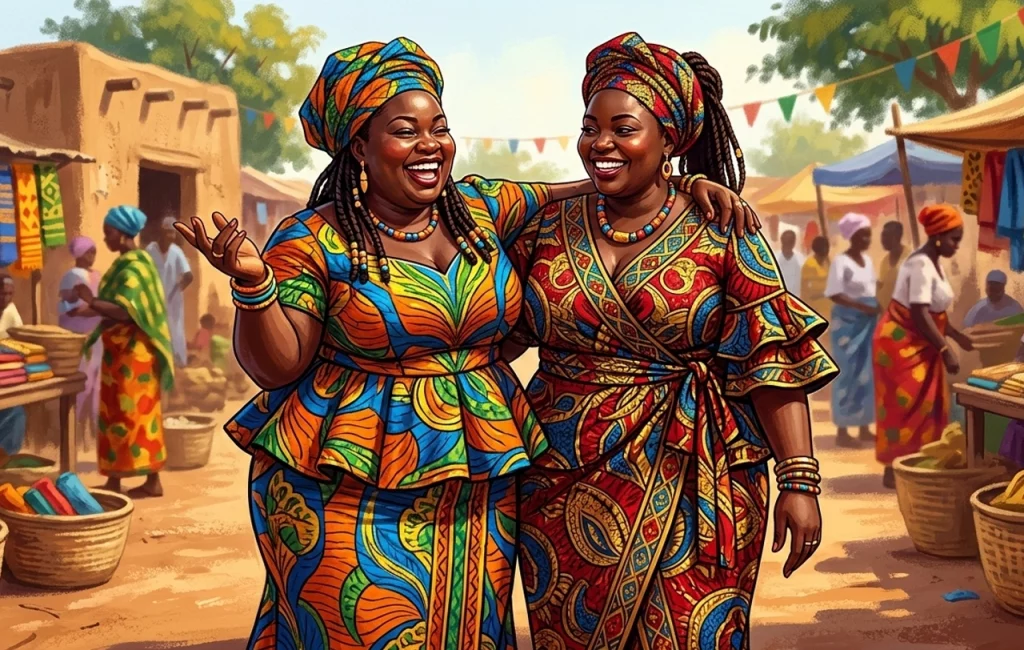
Behind the global myth, women of iron will embodied this success. Their individual journeys are a testament to their strength.
Patience Sanvee: The Diplomatic Icon
Patience Sanvee is undoubtedly one of the most emblematic figures. Starting from nothing, she became the preferred interlocutor for Vlisco directors in the Netherlands. She did more than sell cloth; she advised the government and used her influence to stabilize the market. She embodied imperial elegance, always dressed in her own creations and traveling in the latest Mercedes models.
Eunice Adabunu: The Pioneer
Considered one of the first to structure the wholesale trade in Lomé, Eunice Adabunu paved the way for generations of female traders. She transformed a small market stall into a true international purchasing center, dealing on equal terms with European industrialists as early as the 1950s.
Dédé Rose Gamli (Mama Creppy)
A respected elder, she spanned multiple eras. She was one of the first to understand the importance of collective organization. As honorary president of the cloth retailers’ association, she fought to ensure the women of Lomé kept control over the Grand Market, even in the face of strong political pressure.
The Nana Benz taught us that ambition has no gender, and that trade is an art of diplomacy.
Ekoué Kayi Dogbé
The Grand Market of Lomé: The Epicenter of Power
The Grand Market of Lomé (Assigamé) was their kingdom. At their peak, they managed financial flows representing a significant portion of Togo’s GDP.
An Unavoidable Political Role
Under the presidency of Gnassingbé Eyadéma, the Nana Benz constituted a major political force. They financed the ruling party and were capable of mobilizing thousands of women for large rallies. In exchange, the government guaranteed them commercial protection and customs facilities.
The Shock of Globalization: The Chinese Challenge
Starting in the 1990s, the throne of the Nana Benz wavered under the weight of Asian competition.
- The Price War: Factories in Guangzhou began copying iconic patterns. While a “genuine” Dutch Wax costs between 50,000 and 100,000 FCFA, the Chinese version (often synthetic) sells for as little as 5,000 FCFA.
- The Loss of Quality: While real Wax is 100% cotton and colorfast, Chinese “Fancy” prints flooded the daily market, relegating genuine Wax to a luxury product for major ceremonies.
- The 2013 Disaster: The fire at the Grand Market of Lomé was a finishing blow for many, destroying stocks of fabric accumulated over decades that were unfortunately uninsured.
6. The Legacy: From the “Nana” to the “Nanette”
Today, a new generation is emerging: the “Nanettes.” These are the daughters or granddaughters of the pioneers, often graduates of international business schools, who are reinventing the trade:
- Digitalization: Selling via Instagram and WhatsApp, targeting the global African diaspora.
- Luxury and Certification: They work on authenticity labels and holograms to fight counterfeiting.
- Contemporary Fashion: They collaborate with haute couture designers (as seen during Dior’s famous 2020 Cruise collection in Marrakech) to elevate Wax to the rank of a noble international textile.
Conclusion
The story of the Nana Benz is not just one of commercial success; it is a lesson in female leadership. They proved that financial autonomy is the primary lever for empowerment. By transforming an imported fabric into a cultural symbol and a tool of power, they wove the very identity of modern West Africa.