
Now Reading: At the Source of Strength: Eleven African American Pioneers Who Forged History
-
01
At the Source of Strength: Eleven African American Pioneers Who Forged History

At the Source of Strength: Eleven African American Pioneers Who Forged History

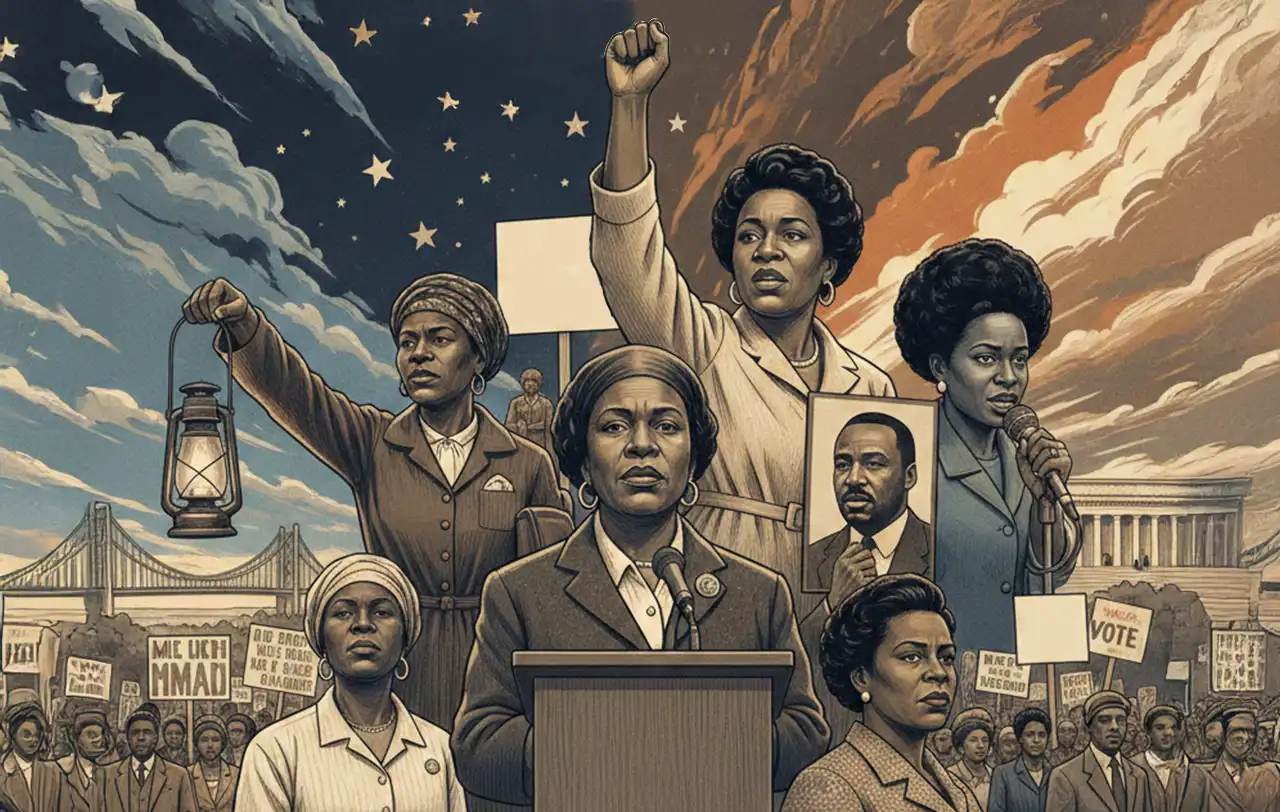
She is proof that the greatest revolutions can start with the simplest of decisions: the decision to stand up by refusing to bow down. Her act resonates as a call to all women who feel invisible: your mere presence, your refusal to be diminished, is already an act of revolution.
The path to equality and justice in the United States was paved by the resilience, courage, and determination of African American women whose impact still resonates today. From one era to the next, these eleven pioneers refused invisibility, transforming their individual struggles into collective movements. From the fierce abolitionism of Harriet Tubman to the powerful eloquence of Sojourner Truth, including the simple yet revolutionary act of Rosa Parks on a bus, each embodied an essential chapter of Black liberation. Their stories, alongside figures like Dorothy Height, Shirley Chisholm, and Fannie Lou Hamer, chart a course for empowerment. They are living proof that unwavering conviction, driven by authenticity and strength, can shake the foundations of a nation. Their lives are the fertile ground from which inspiration springs for every Black woman today.
Rosa Parks: The Act of Silence That Shook America
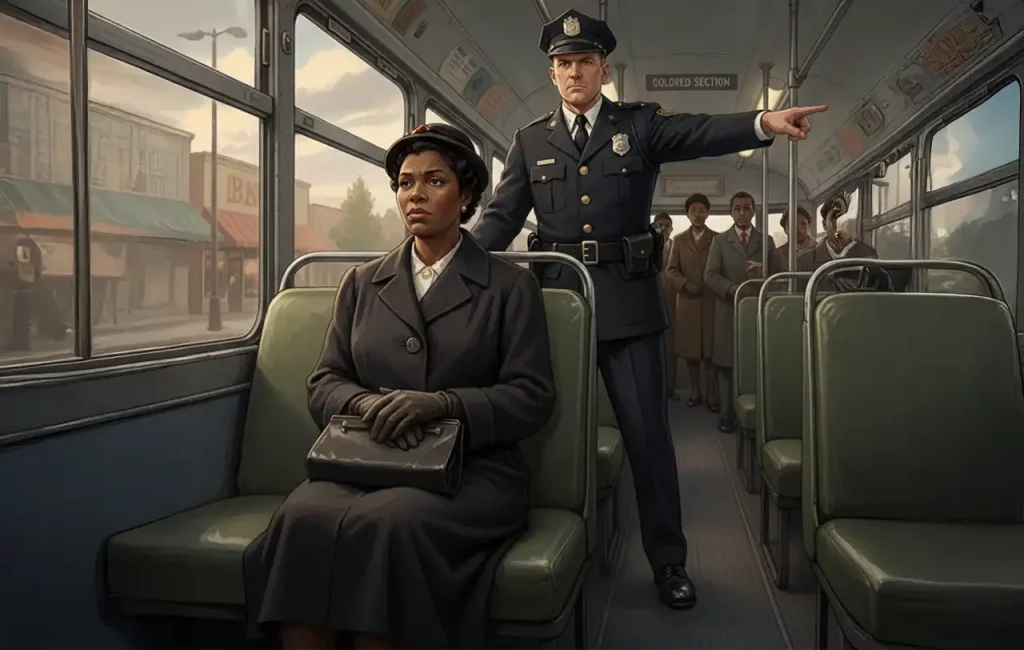
History often features the spectacular, with fiery speeches and marching crowds. Yet, one of the most powerful and foundational acts of the American Civil Rights Movement was a gesture of silence and motionless resistance: the refusal of Rosa Louise McCauley Parks to give up her seat on a bus in Montgomery, Alabama, on December 1, 1955.
This simple “no” to injustice, spoken by a 42-year-old seamstress, was not the impulsive act of a citizen tired after a long day. It was the culmination of a lifetime of discreet, measured, but deeply rooted commitment that would catalyze the Montgomery Bus Boycott and forever transform the fight for racial equality in the United States.
Far More Than a Tired Seamstress
The popular image of Rosa Parks is often that of a middle-aged woman, exhausted, whose act was spontaneous. This simplification obscures the depth of her commitment. Long before that December day, Parks was a seasoned and respected activist.
- Early Activism: As early as the 1930s, she and her husband, Raymond Parks, were active members of the National Association for the Advancement of Colored People (NAACP). She served as secretary of the Montgomery chapter and later as a youth advisor, training the new generation in nonviolent tactics of resistance.
- Activist Training: Just months before her arrest, Rosa Parks attended a workshop on activism and workers’ rights at the famous Highlander Folk School in Tennessee, an essential training ground for progressive leaders in the South. Her act was therefore calculated and supported by strategic training.
On December 1, 1955, as she boarded the bus, she knew she was taking a calculated risk, and, along with other NAACP leaders, she was prepared for her case to serve as a legal test.
The Catalyst for Change
In Montgomery’s segregation system, buses were divided: Black people had to sit in the back and surrender their seats to white people if the “white” section was full. The driver, James Blake, ordered Parks and three other African Americans to stand up. Parks was the only one who refused.
Her immediate arrest had a ripple effect. The Women’s Political Council (WPC) and young pastors, including a certain Martin Luther King Jr., immediately organized a total bus boycott for the following Monday.
The Montgomery Bus Boycott lasted 381 days. It was an unprecedented act of collective resistance. Thousands of Black citizens, often domestic workers, custodians, and laborers who depended on buses to get to work, chose to walk, carpool, or use cooperative taxis, putting unbearable economic pressure on the city and its public transit.
This event propelled Martin Luther King Jr. to national leadership and forced the U.S. Supreme Court to issue a ruling. In November 1956, the Court ruled that segregation on public buses was unconstitutional.
A High Personal Price
Rosa Parks’s act had devastating personal consequences. She and her husband lost their jobs. Faced with death threats and continuous ostracism in segregationist Alabama, the couple was forced to move to Detroit, Michigan, in 1957.
Far from retiring, she continued her civil rights work. From 1965 to 1988, she served as secretary and receptionist for Democratic Representative John Conyers, a founding member of the Congressional Black Caucus. Even in her later years, she co-founded the Rosa and Raymond Parks Institute for Self-Development, an educational center for youth.
The Legacy of Dignity
Rosa Parks passed away in 2005 at the age of 92. Her legacy does not only lie in triggering a legal revolution. It lies in the demonstration that quiet dignity is a powerful weapon. She proved that nonviolent action, carried out by one individual at the right time, can unlock decades of injustice.
Her story is a reminder that activism does not always require a megaphone; sometimes, it only requires a seat one refuses to vacate. Rosa Parks transformed the public space of the bus, a place of daily segregation, into a battleground for freedom and equality, leaving behind a model of civil courage that transcends generations.
She is proof that the greatest revolutions can start with the simplest of decisions: the decision to stand up by refusing to bow down. Her act resonates as a call to all women who feel invisible: your mere presence, your refusal to be diminished, is already an act of revolution.

Related Posts



Stay Informed With the Latest & Most Important News
Previous Post
Next Post







Advertisement

A WordPress Commenter
Hi, this is a comment.
To get started with moderating, editing, and deleting comments, please visit the Comments screen in the dashboard.
Commenter avatars come from Gravatar.
Julien Fouejeu
This is our history, we deserve to know